An Epoxy Garage Floor Quote Holds at the Edges
A garage floor quote usually goes soft at the edge.
The field—the open rectangle in the middle—is easy to measure and easy to price. The edge is everything else: the stem wall that needs cove base, the step, the threshold at the garage door, the control joints, the cracks, the post base. Those conditions are not square-foot items. They are linear-foot items, or each items, and if they are not in the quote, the number does not hold when the grinder starts.
The fix is not a longer quote. It is a quote that separates what you can see from what you find, and puts a price on both.
The square foot is a field price, not a floor price
A square-foot price is useful. It is how you compare jobs, and how customers compare you. But it is a field rate. It covers the open floor. It does not know how much edge the floor has.
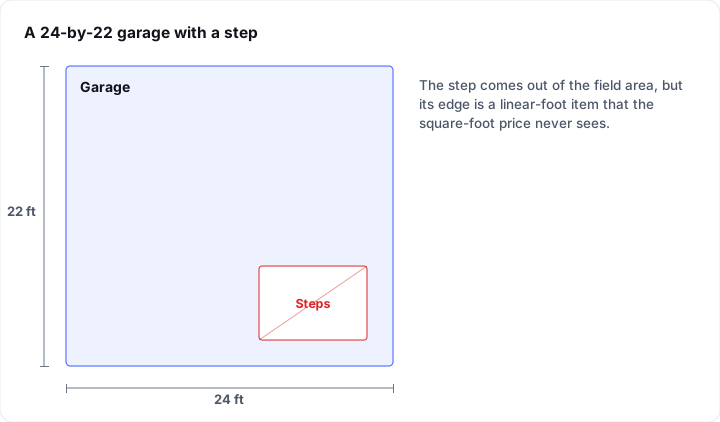
A plain 24-by-22-foot garage is 528 square feet. That is the field. The same rectangle has 92 linear feet of perimeter. If the wall has a stem that needs cove base, that is 92 feet of extra prep, material and labor. The square-foot rate does not know that.
Put a step in the corner and the field area drops, but the edge grows. The step face, the riser, the little return at the side—those are linear feet. A one-rate quote treats them as if they were free.
A quote gets soft right there. Not because the square-foot price is too low, but because it is being asked to cover work it was never built to cover.
The edge is also where callbacks start. A cove base that lifts or a step edge that gets too thin is a return trip. Pricing the edge is how you pay for doing it right the first time.
Measure the edge, not just the field
On the walkthrough, keep two lists. The field list is square feet. The edge list is linear feet and each. Do not let them merge into 'garage floor, 528 sf.'
Four columns are enough: item, unit, quantity, rate.
The common edge conditions:
- Perimeter at a stem wall: cove base, if the job calls for it.
- Steps and curbs: the horizontal tread and the vertical face are separate runs.
- Garage door threshold and side returns.
- Control joints, cracks and spalls: linear feet or each, depending on the repair.
- Posts, drains and other penetrations: each.
Measure each one. Write the number next to it. If a condition is hidden until you grind, leave the quantity blank and carry the unit price. That is not a weak quote. That is a quote that tells the truth about what is known.
Keep the field measurement separate even after you have the edge list. The field tells you how much coating to buy. The edge tells you how much labor the job really takes. Mixing them hides both.
An allowance is a guess. A unit price is a number.
An allowance is a placeholder: a dollar figure for repairs. The customer hears a number. You hope it is enough. If the slab needs more, you either eat the difference or go back with your hand out. Both make the original number look soft.
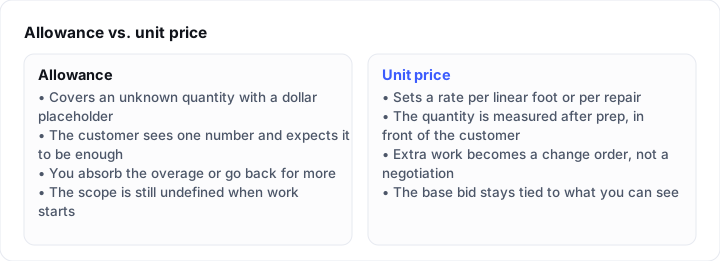
An allowance also makes the quote hard to compare. Your number includes a repair guess. The next contractor's number may not. The customer sees a higher total and does not know why.
A unit price is different. It says crack repair is a rate per linear foot, measured after prep. Spall repair is a rate per square foot. Coating removal is a rate per square foot. The customer agrees to the rate, not to a guess. When the work is measured, the change order is arithmetic.
That is what makes the number hold. The base bid stays tied to what you can see. The unit prices handle what you cannot. The customer can add work without asking for a new quote, and you can say yes without renegotiating the whole job.
The quote needs a base, not a range
Every quote should have one base bid for a defined scope. Write the scope in plain words: what surface, what prep, what coating system, what edges are included, what is excluded. If cove base is included, say so. If the step is included, say so. If the garage door threshold is not, say so.
A base bid with a clear boundary is easier to defend than a low number with a long list of 'additional work as needed.' The customer does not want a mystery. They want to know what the number buys.
A range is not a quote. 'Between this and that' tells the customer you have not done the work of measuring. If you cannot see the slab, say what you cannot see and price it as a unit. Do not bracket the whole job.
The base bid can still be competitive. It just cannot be vague.
What to do on the walkthrough
Walk the perimeter first, before you measure the field. The edge sets the scope. Then measure the field. Then price from your price book, not from memory.
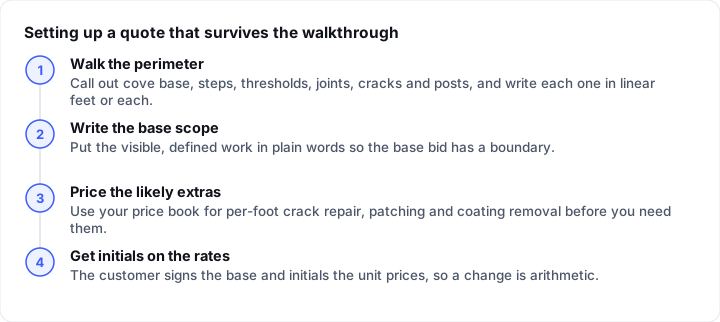
Do this before you leave the driveway. The quote written from memory is the one that loses the step, the cove base and the crack repair at the door.
If you draw the room on a phone or tablet, Drawlite measures the drawing and prices it from your own price book. That keeps the quantities tied to the floor you just walked instead of a note you rewrite later. The number on the quote is the number you measured.
Get the customer to initial the unit prices. Not just sign the bottom. The initials are the difference between a conversation and an argument later.
The steps are simple, but they only work in order. If you price the extras after the customer asks, you are negotiating against yourself. If you write the base scope last, the edges are already missing.
The number holds because the scope is boring
The quote that holds is usually the boring one. It has a base bid, a short scope, a list of unit prices and a sentence about what happens if the slab is worse than it looked. It does not have a single square-foot number pretending to cover every condition in the garage.
On the next floor, price the field by the square foot. Price the edge by the foot. Price the unknown by the unit. Then the number holds—not because you guessed better, but because you stopped guessing.