Where Epoxy Garage Floor Quotes Leak Money
The price is the last thing you say and the first thing the customer repeats to their brother-in-law. But the number is rarely what breaks a quote. The scope behind it is.
You quote a two-car garage, full flake, two clear coats. The customer says yes while you're still standing in the driveway. Three days later you're grinding around a step you didn't measure, patching a spall that was hiding under a stack of tires, and rolling a third clear coat on a floor that drank the first two. Nobody renegotiates. You just finish the job for less than you bid. Then the next quote carries a little padding to cover the last one, and before long you're losing jobs you should have won.
Holding the number is mostly about writing down what you already know while you're still in the garage.
Length times width is the least useful number
A 24 by 22 garage sounds like 528 square feet. Walk it and it usually isn't. There's a 3-foot step up to the house door, a curb along the back wall, a floor drain, and a stem wall the customer wants coated because that's how the garage looked in the photo they saved on their phone.
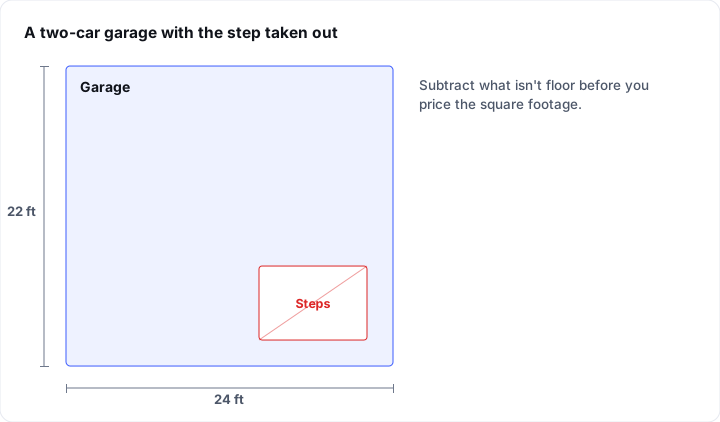
The coating covers the floor. The work includes edges, and edges aren't measured in square feet. Measure the floor and subtract what isn't floor. Then walk the perimeter on its own: stem walls, curbs, the apron at the door, the threshold. Cutting in takes a brush instead of a roller, a slower pace, and material you weren't counting on. If those feet aren't on the quote, they're on you.
Deductions matter twice. Once for the material you don't need, and once for credibility. A quote that claims 528 square feet when the customer can see the step is a quote they'll question item by item.
Leak one: prep priced as a step, not as hours
Almost every quote contains the word "prep." Almost none of them say what prep costs, because prep is invisible to the customer and unpleasant to think about.
Two garages the same size can be half a day apart, or two days apart. A bare slab with light dust grinds quick. A floor with peeling paint, or a coating someone else installed that failed, has to be stripped, and stripping is slow, dusty work that eats diamond tooling. Cracks get chased, cleaned out and filled. Spalls get cut out and patched, and the patch has to cure before anything goes over it. Every one of those is hours.
Price prep like any other labor: the hours you expect, times your rate, plus the tooling and patch material it burns. If you price it as an afterthought, you aren't quoting prep. You're donating it. And use your own history. What the last five floors like this actually cost you beats what you hope this one will.
Leak two: flake and clear, the half the customer judges later
The flake is the first thing the customer looks at and the last thing you want to think about while you're tired and trying to get the quote out of the truck.
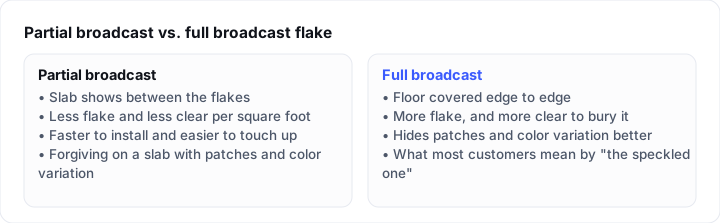
Two decisions live here, and both of them are money. How much flake, and how much clear. Partial broadcast leaves slab showing between the flakes and reads as a lighter, more mottled floor. Full broadcast covers the floor edge to edge, and it takes more clear to bury the flake so it doesn't feel like sandpaper or shed into a broom. Full broadcast is more flake and more clear per square foot, and it's also the floor most customers are picturing when they say they want "the speckled one."
Write the count into the quote. "Base, full broadcast, two coats of clear" is a scope. "Clear coat included" is a coin flip, and you lose the coin flip.
Leak three: the slab that says no
Moisture is the failure that shows up after you've been paid and after the customer has parked the car back inside. A slab passing vapor will lift a coating no matter how well you prepped it, and by the time you find out, you're not quoting anymore. You're redoing.
Test before you put a number on paper, not after. Then write the result on the quote, along with what you're doing about it — a moisture-tolerant system, a longer cure, or a straight conversation about why this floor isn't getting coated today. The customer reads that as care. If you'd rather not write it down, that's usually a sign it needs to be looked at again.
Leak four: the freebies and the money after the number
Every job has a few hours that don't appear anywhere. Hauling the debris. Trimming around the drain. Moving the water heater and putting it back. The customer who upgrades the flake after watching you drop the sample on the floor. The extra clear coat because the slab drank the first one.
Some of that you eat on purpose, and that's fine — you just can't eat it on purpose if you never counted it. Put an exclusion list on every quote: repairs hidden under the existing coating, moving appliances and stored items, and anything else outside what you walked. Whatever you're not doing, write it down. It isn't a warning to the customer. It's an agreement between two people about where the job stops.
Then there's the money itself. A quote that doesn't state a deposit and when the balance is due invites a conversation at the end of the job, and that conversation is a discount you didn't plan to give. State the deposit, state the terms, and get it signed before the grinder comes off the truck.
Write the scope, then the number
By the time you say a price, the customer should already know what the price is for. Four things do that work.
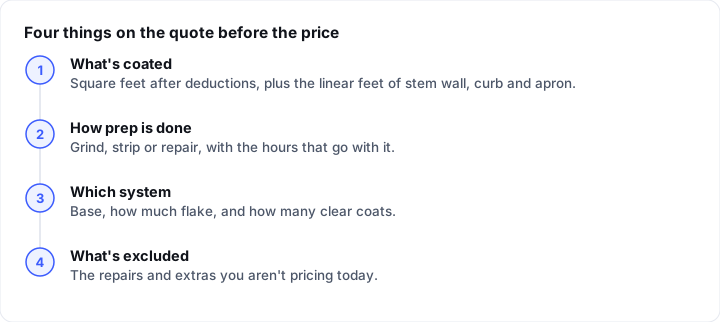
None of it is complicated. It's just the opposite of the way a lot of quotes get written, which is a square foot number, a phone call, and a handshake. The number that holds is the one with a scope under it, priced from what your own jobs actually cost instead of what you hope this one will.
And it's worth doing the drawing where you're standing. Drawlite lets you draw the garage on a tablet at the customer's house so the drawing measures itself — the square footage and the perimeter come off the room in front of you instead of off your memory. Your own price book prices it, the systems you sell most are already built as reusable templates, and the quote goes out with the scope attached, so what the customer signs is what you priced. More at https://drawlite.com.
A quote isn't there to win the argument about price. It's there to end the argument about scope before it starts. Get the slab, the prep, the system and the exclusions on paper while you're standing in the garage, and the number you say out loud is the number you get paid.