The Number Holds When the Scope Does
The low number is not the problem
When a homeowner gets three quotes for an epoxy garage floor, the low one usually looks clean. One price, one square-foot rate, one line that says “prep included.” The other quotes have pages of detail and a higher number. The homeowner is not wrong to ask why.
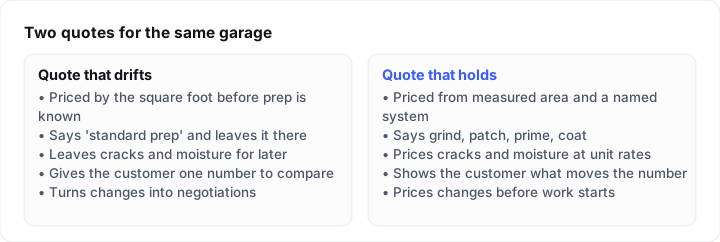
The low quote usually is not lying. It is incomplete. It may be priced on the garage footprint instead of the coating area. It may assume a broom-clean slab and no moisture. It may leave out cove base, the stem wall, crack repair, or the cost of moving a garage full of stored boxes. The number is real. It just does not cover the job.
A quote that holds does the opposite. It makes the job visible before the price. The customer can still choose a cheaper system, but they cannot say later that they did not know what the number included.
Measure the floor you are coating, not the garage you are standing in
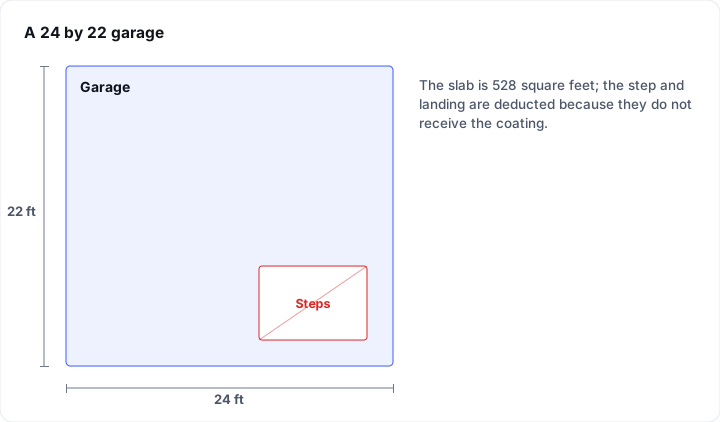
Start with a tape, not a rate. A 24-by-22 garage sounds like 528 square feet. It is not 528 square feet of coating if there is a step, a landing, a utility pad, or a stem wall that is not getting coated. Measure the actual floor area that will receive the system. Then measure the linear feet of cove base, stem wall, thresholds, and any steps.
The same walk should record what the slab is doing. Oil spots. Tire marks. Paint. Old sealer. Hairline cracks. Wider cracks. Spalls. Pits. Efflorescence. A slab that sounds hollow under a chain drag. Any of these can change the prep and the price. If you measure only the flat area and ignore the edges, the quote will hold right up to the first crack that needs chasing.
Moisture testing belongs in the walk, not in a hope. Test the slab and write the result on the quote. If the test says the slab needs mitigation, the quote either includes it or names it as an exclusion with a unit price. A floor that blisters later is not a quote problem. It is a scope problem that became a callback.
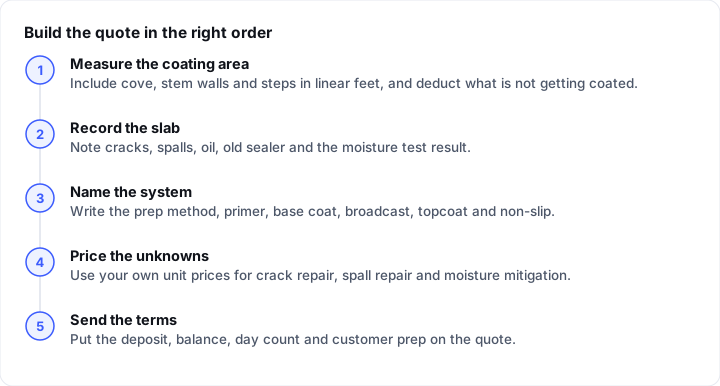
Put the quote together in the right order
The order matters. If you start with a square-foot rate, you will spend the rest of the quote defending it. Start with the job.
Price the system, not the square foot
A square-foot price is an output. It is what the job costs divided by the area. It is not an input you guess before you know the system.
The system includes the prep method, the primer, the base coat, the broadcast, the topcoat, and the non-slip. It also includes the edges: cove base, stem walls, and steps. A flake floor broadcast to rejection is not the same job as a thin roll-on coat. A metallic floor is not the same job as a solid color. A slab that needs grinding, crack chasing, and patching is not the same job as a clean, sound slab.
Name the system on the quote. List what it includes. Sell the system, not a pile of line items the customer has to assemble. Then price it from your own numbers. This is where a price book in Drawlite earns its keep: the system pulls your numbers instead of your memory. If you price from memory, you will remember the coating and forget the grinding.
Write the scope so the price cannot drift
The number holds when the words around it hold. “Prep included” is not a scope. “Diamond grind, fill cracks up to the allowance below, prime, base coat, broadcast to rejection, topcoat” is a scope. It tells the customer what they are buying and tells you what you have to deliver.
Put exclusions in the same plain language. The quote should say who moves the stored boxes, who removes the old shelving, who repairs drywall, who handles electrical outlets, and what happens if the slab needs moisture mitigation. If the customer is going to park on the floor after a certain number of days, write that day count down. If the garage must be empty before the crew arrives, write that down too.
Price the unknowns before they become arguments
Every garage has unknowns. The trick is not to pretend they are not there. The trick is to put a number on them before the work starts.
Use unit prices from your price book. Crack repair by the linear foot. Spall repair by the square foot. Moisture mitigation by the square foot. Cove base by the linear foot. Extra stem wall by the linear foot. If the unknown does not show up, the customer does not pay it. If it does, the price is already agreed.
That is better than a contingency line the customer does not trust, and better than eating the repair because it was not in the quote. It also keeps the original number honest. The base quote covers the base job. The unit prices cover what the slab actually needs.
Put the payment terms and the day count on the quote
A quote that holds also says how the money works. A deposit that covers material before the crew starts. A balance due when the job is done. The payment terms should be on the same page as the scope, not in a text message after the work is finished. Put the deposit and the balance owed on the quote so the customer sees the whole deal at once.
The day count matters too. When can they walk on it? When can they put the car back? When can they move the shelving in? Those answers are part of the product. A customer who is told one cure time and hears another from a neighbor will call you. A customer who sees the day count on the quote has a reason to trust the number.
Check the quote before you send it
Before you send, read the quote as if you were the customer. Can you tell what is being coated? Can you tell what is not? Can you tell what changes the price? Can you tell what you have to do before the crew arrives?
Then read it as the contractor. Did you measure cove and stem wall? Did you record the moisture test? Did you price the cracks? Did you include the non-slip? Did you leave enough margin to cover the time you will actually spend? A reusable template helps, because it makes you answer the same questions on every garage instead of the ones you happen to remember. Drawlite’s margin guard and templates are built to catch that, but the discipline is yours.
A number that holds is a promise you can keep
The customer is not buying a square-foot rate. They are buying a floor that will still be there when the boxes come back. The quote is the promise. If it is thin, the promise is thin. If it is complete, the number holds because the scope holds.
You do not have to be the cheapest quote in the driveway. You have to be the one the customer can understand. Measure the coating area. Name the system. Price the unknowns. Write the exclusions. Put the payment terms and the day count on the page. Then send the number.