How to Build an Epoxy Garage Floor Quote That Holds
A quote is a scope with a number on it
A garage floor quote is one page. The job is two or three days, and at least one of those days contains something you could not see from the driveway.
When a contractor loses money on an epoxy floor, it is rarely because the price was too low when they said it. It is because the price covered a floor they were not actually coating by the second morning. The cracks ran further than they looked. The oil stain had soaked in. The customer cleared half the garage and left the rest of it. None of that was written down, so the extra work came out of the number instead of being added to it.
A quote holds when three things are true. It is priced on the area you will actually coat. It names the prep you will actually do. And anything past that is a change order the customer signs before you touch it.
Measure what you are coating, not what you are standing in
A two-car garage is not 24 feet by 22 feet of coating. It is 24 by 22 minus the stem wall, minus the step at the back where the water heater sits, minus the pilaster in the corner. On paper that looks like a rounding error. On a job, it is the difference between a number that works and a number you quietly shave down.
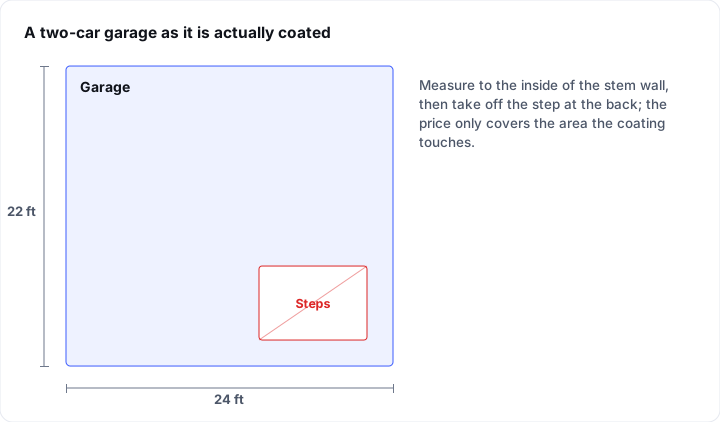
Walk it with a tape before you say anything out loud. Measure to the inside of the stem wall. Note every place the coating stops. If shelving runs along one wall, decide now whether you are coating under it. We could not get behind the shelves is not a sentence you can bill for after the fact.
Two more things while you are standing there. Count the cracks in feet, not in a few, because crack repair is the line that moves most. And look at what is already on the floor: sealer, paint, an old epoxy job peeling at the edges. Each one is a different job from the bare slab you are picturing.
This is where Drawlite earns its place. You draw the garage on a phone or tablet in the driveway, it measures the drawing, and it prices it from your own price book. The square footage in the quote is the square footage you walked, not the square footage you estimated at the kitchen table that night.
Decide the system before you decide the number
Epoxy is not one product. It is a range, from a thin rolled coat to a full broadcast floor with primer, base coat, flake and topcoat. The materials cost differently, the prep is different, and the floor lasts differently.
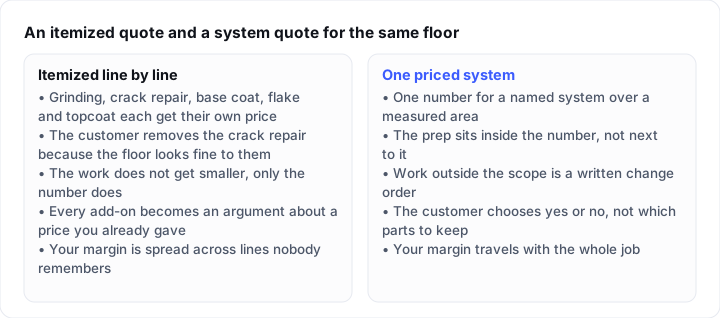
Pick the system first, then price it. Say out loud what the customer is buying, in the words you will put on the quote. A price built backwards -- a number you think will win, then a system that fits inside it -- is a number that fails on the second day, because the only way to hit it is to cut the prep. Cutting the prep is what makes coatings peel.
The other reason to sell one system instead of a list is that a list is a menu. The customer reads it and takes out the crack repair, because from where they are standing the floor looks fine. Your number drops by that line. The work does not drop at all.
Price the number so it can absorb a bad day
Say you quote $6.00 a square foot on a 528 square foot garage. That is $3,168, and it has to cover five things: materials, labor for prep and installation, grinding equipment and consumables, overhead, and profit.
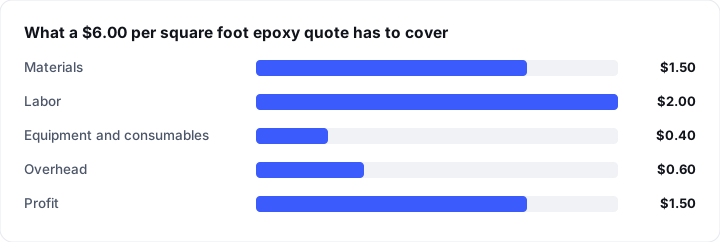
In that example, materials take about $1.50 of each square foot. Labor -- grinding, crack repair, masking, rolling, flaking, topcoating, coming back the next day -- takes about $2.00. Equipment, blades and rollers take $0.40. Overhead takes $0.60. Profit is the last $1.50.
Now run the day that goes wrong. Prep takes longer than you planned. The money for it comes out of the last line, because you cannot take it out of materials and you cannot take it out of overhead. Twenty extra minutes per hundred square feet across a garage that size is real money, and on a job this size it is the profit.
That is the argument for naming the prep you might need inside the number instead of hoping you will not need it. Not padding. Naming. If your own history says one garage in five needs more crack repair than expected, put an allowance on the quote and write down what happens when the allowance runs out.
Your numbers will not match the ones above, and they should not. The point is that you should know yours, per square foot, before you say a price out loud. Drawlite keeps win rate and margin on the quotes you have already sent, which is a better teacher than memory.
Write down what is not included
The exclusions are the part of the quote that holds. Put them on the page, in plain sentences, above the signature line. Something like:
- Grinding of the full coated area is included.
- Crack repair is included up to a length you set. Past that, it is a per-foot price as a signed change order.
- Spot treatment of oil and grease is included. Stains that have soaked into the slab are not.
- Existing coatings, sealer, paint and spalling are not included. If we find them once the floor is ground, work stops and we re-price.
- The garage is empty, clear, and has power and water on the day we start.
Then moisture, in one line. If you have not tested the slab, you are quoting the top of a floor and hoping about the bottom. Either test it or exclude floors with no vapor barrier under them, and write the result on the quote. That is a sentence on an estimate, not a project.
Put a photo on the quote
Phone photos cost nothing. Take the whole floor from the door, each crack you can see, the oil stains, the step at the back, the moisture reading, and the spot where the old coating is lifting.
Attach them to the quote. Two things happen. The customer sees the cracks before the job, so when you tell them the crack ran further than it looked, they remember the picture. And when the next bidder says the floor can be flat and smooth for less, the customer is holding a written scope that says what less leaves out.
Ask for the deposit, then follow up twice
A number holds better when money is attached to it. Deposit on signature, before materials are ordered, so the resin sitting in the back of the truck is the customer's money and not yours.
And most quotes that go cold are not lost on price. They are lost because nobody asked again. Two follow-ups, spaced out, with the scope attached to the second one. A quote sitting in a message thread is worth nothing.
The number holds when the scope holds
You cannot control the slab. You can control whether the quote describes it. Measure the area you are coating, pick the system, price the prep you might need, write the exclusions, attach the photos, and take the deposit. Then the work outside the scope is a change order instead of a haircut, and the number you said in the driveway is the number you get paid.