Why a Quote Sent the Same Day Wins More Often Than a Better Price Sent Friday
The Friday quote lands in a different conversation
You walk the job on Tuesday. You measure, take photos, write down the cabinet run, the step, the outlet that has to move. You tell the customer the quote will be over by Friday. Friday comes, you send a clean number, and it sits there.
By then the customer has heard from two other contractors. A neighbor has an opinion. The room has gone back to being a room instead of a project. Your quote is no longer the record of a conversation you had together. It is a document in an inbox next to a cheaper one-number bid from someone who may not have looked at the same details.
That is the gap a same-day quote closes. Not because the price is lower. Because the customer is still standing in the room.
What the customer is actually buying
The customer is not only shopping for the lowest number. They are trying to get rid of a worry: Will this person stand behind the work? Did they see the problem? Will the price hold? What happens if something is behind the wall? Price is one part of that. Certainty is the rest.
A quote sent the same day is proof that the job got your attention. The customer can ask what a line is for, and you can point at the wall. They can ask whether the old floor comes up, whether the trim stays, whether the price includes disposal. You can answer while the details are fresh. On Friday those questions turn into a phone call, then a voicemail, then a quiet no.
The better-priced quote loses for a simple reason: it did not do the same job of explaining. A low number with a vague scope creates more questions, not fewer.
Delay turns a scope comparison into a price comparison
A good quote lets the customer compare. It shows what is included, what is excluded, and what choices change the number. Even then, the customer may not read it closely. If the quote arrives three days late, they read it even less.
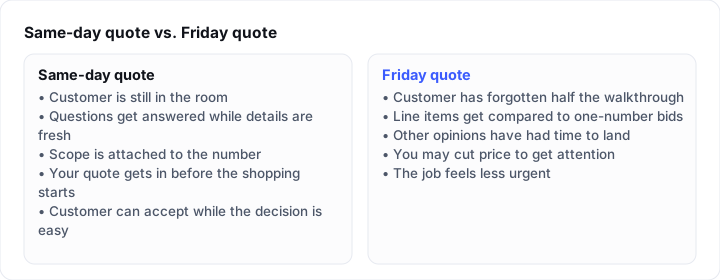
On Friday your line items get compared to whatever is easiest to see. That is usually a total. The other contractor may have sent a single number with no scope. If the customer is tired, the single number wins the first look. You then have to explain why your number is higher after the moment has passed.
The same-day quote gets in before that comparison hardens. It does not have to be perfect. It has to be clear, tied to what you saw, and easy to accept.
The Friday discount is not a small cut
Here is where the better price on Friday gets expensive. Say the job prices at $9,800. Materials are $2,300, crew labor is $4,200, and overhead is $1,400. That leaves $1,900 of margin.

The customer says the other quote is $600 less. You cut $600 to keep the job. The new price is $9,200. The costs are the same. Margin is $1,300.
The customer saved about 6% on the price. You gave up $600 out of $1,900 of margin, which is about 32% of the margin. Same work. Same risk. Less room for the thing that always shows up: the extra dumpster run, the soft spot in the concrete, the second trip for the right trim.
Before you cut, run the number through the markup vs margin calculator. A $600 cut sounds small until you see what it does to the margin. Sometimes a discount is the right call. It should be a decision, not a reaction to being late.
How to send it the same day without cutting corners
Same-day does not mean guessed. It means doing the work in the right order.
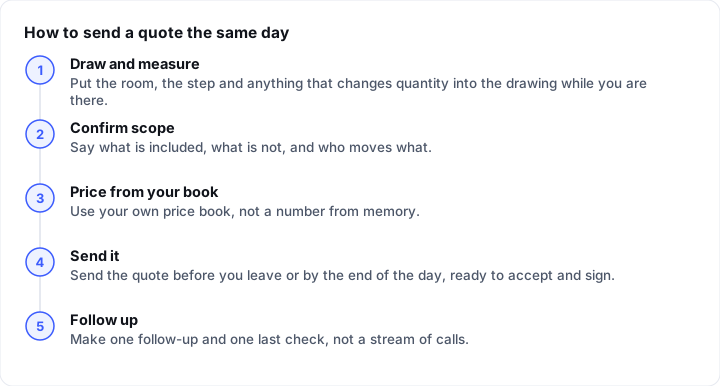
You do not have to rush. You have to do the same few things every time.
1. Draw the room while you are in it. Include the step, the alcove, the closet, the cabinet run. If it changes the quantity, it goes in the drawing. 2. Confirm the scope in plain words. What is included. What is not. Who moves the furniture. What happens to the old material. 3. Price from your own book. Not from memory. Not from a number that felt right on the drive. Your price book is the difference between a fast quote and a fast mistake. 4. Send it before you leave, or by the end of the day. A quote the customer can accept and sign beats a promise to send one. 5. Follow up once. Then once more. The follow-up is not nagging. It is the difference between a quote in a pile and a decision.
This is the part where the tool matters, and only this part: Drawlite is built for that sequence. You draw the room on a phone or tablet, it measures the drawing, prices it from your own price book, and sends a quote the customer can accept and sign. It can follow up automatically if the quote goes quiet. The rest is still you: the walkthrough, the scope, the judgment.
What to do when one number is missing
You will not always have every price on the first visit. A special-order door. A cabinet run. A moisture test on a concrete floor. Waiting a week for one line is how a same-day quote becomes a Friday quote.
Send the scope and the price you know. Mark the open line clearly. Say what it will cover and when you will confirm it. A customer can say yes to a quote with one clearly labeled allowance. They cannot accept silence.
The same rule applies to choices. If the customer is deciding between two finishes or two fixture levels, put both in front of them while you are there. Finishes, fixtures, and a design view are easier to talk about in the room than over a text thread three days later.
The quote is a habit, not a burst of energy
A same-day quote is not about typing faster. It is about not losing the details between the walkthrough and the desk. Measure properly. Write the scope plainly. Price from the book. Send before the details fade. Use templates for repeat work and your own past work as proof, so you are not starting from a blank page at 8 p.m.
Speed is a habit. So is delay. Delay is easier, because nobody complains when a quote is late. They just stop calling.
If you want to see whether the software fits the way you already quote, what Drawlite costs is here. The point is not to send a quote faster for its own sake. The point is to be in the conversation while the room still matters.