What a Square-Foot Price Really Has to Cover
The price per foot is a quotient
A square-foot price is the answer to a division problem. You add up what the job costs, add what you need to keep, and divide by the square feet. The number looks clean because the division is clean. The costs are not.
Two garages can both measure 24 by 22 and need different prices. One has a slab poured last spring and swept clean. The other has twenty years of oil, a web of cracks, and a step the customer wants coated up the riser. The square footage is the same. The job is not.
That is the trap. The per-foot number travels. You use it on the next call, then the next. Pretty soon it is not a result, it is an assumption. The costs that made it are still sitting on the job, waiting to be covered.
Measure the floor you actually coat
Start with the plan area. Then take off what you do not coat and add what you do. A 24 by 22 garage is 528 square feet on paper. Steps take a bite out of the floor. Cove base, the stem wall, the apron at the door, the threshold — those are linear feet, not square feet, and they take time.
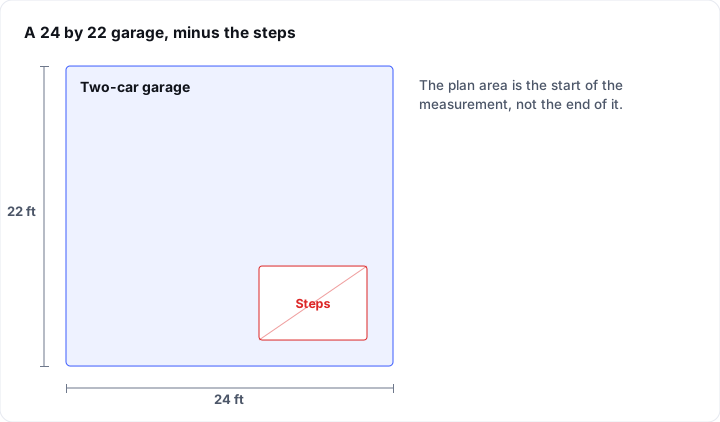
The perimeter of that garage is about 92 linear feet before the door opening. At 4 inches up the wall, the cove is not much square footage. It is a lot of hand work. If you price the floor by the flat area and forget the edge, the edge comes out of your margin.
528 square feet is a two-car garage. If you price it as 528 square feet of flat floor, you have priced a different job than the one in front of you.
Measure the coated area. Count the edge. Include the space behind the water heater and under the steps if the customer expects it coated. Add waste for material — coating, flake, trim — because the last square foot in a bucket is not free. The epoxy floor cost calculator lays those lines out off the room's own dimensions.
The costs that do not shrink with the floor
Some costs are per job, not per foot. The grinder, the diamonds, the vacuum, the masking, the drive, the dump fee, the setup, the cleanup. A one-car garage and a three-car garage both need the equipment unloaded and the floor ground. The big floor spreads those costs over more feet. The small floor carries them on fewer.
That is why one per-foot price can be right for a shop floor and wrong for a single bay. A 240-square-foot single bay is not half the work of a 480-square-foot double. It is the same setup on half the area. If you use the same rate, you are either overcharging the big floor or paying to do the small one.
Overhead has the same problem. Insurance, the truck, the phone, the software, the warranty you honor two years later when a coating lifts at a control joint. None of it doubles when you add a second coat. It sits on the job. So does the profit you need to stay open.
A worked example: what $6.00 a foot has to hold
Take a 24 by 22 garage, 528 square feet, minus 24 square feet of steps. Call it 504 square feet of coated floor. At $6.00 a square foot, the job is $3,024. That is the number the customer hears.
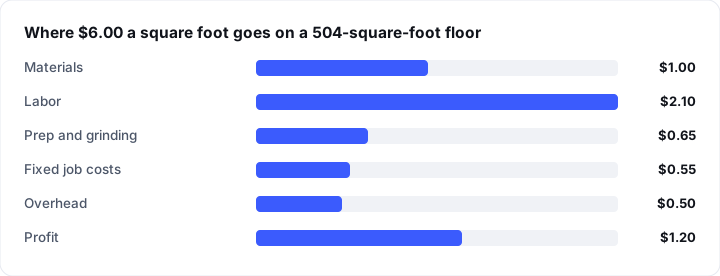
Here is what that number has to cover in this example. These are example costs, not a market rate. Your numbers will be different. That is the point.
Change one line and the rate moves. If the slab needs a second pass with the grinder, prep goes up. If the customer wants a full flake broadcast and a clear topcoat, materials go up. If the job is across the county, the fixed line goes up. None of those add square feet. They add cost.
Material coverage is another one. A bucket covers a range, not a guarantee. Ordering to the exact square footage and running short means a second trip and a batch that may not match. Waste belongs in the material line.
Profit is the line that gets squeezed last and noticed first. If you take $1.20 out of that price to win the job, you are not cutting 20 cents a foot from profit. You are cutting the money that covers the next callback. The markup vs margin calculator is useful here because markup and margin are not the same number, and a target margin tells you the price you have to charge, not the price you hope to get.
Build the number from the bottom up
Keep the per-foot price honest by building it after the job, not before it.
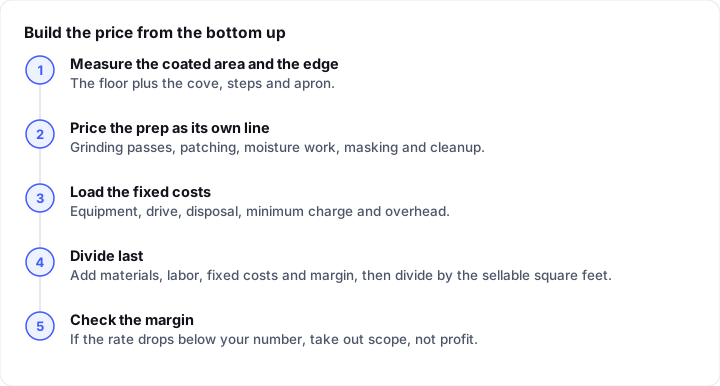
A dime a foot on 504 square feet is $50. It sounds small until it comes out of the profit line on every job. The per-foot price hides those changes because it is one number.
That last step matters. A lower per-foot price is easy to say and hard to carry. If you need to hit a customer's budget, reduce the scope in writing: one coat instead of two, no cove, no flake, a smaller area. Do not keep the scope and cut the number. The job does not get cheaper because the quote did.
Say the scope, not just the rate
A per-foot price is a summary. The customer hears a rate. You are carrying a scope. The two need to match in the same conversation.
When you send the quote, show what the number includes: the square footage you measured, the prep you are doing, the edges and steps, the material build, and what is not included. If the slab needs moisture testing before the coating goes down, put it in as a line, not a surprise. If the price assumes the customer moves the boxes and the car, write that down. A rate without those lines is not a price. It is a guess with a dollar sign on it.
The customer may ask for a single rate before you have seen the slab. Give a range and say what moves it — prep, coating build, edges. A range with reasons is more useful than a rate with none.
Drawlite is built for this. You draw the room on the phone or tablet, it measures the drawing, and it prices from your own price book. The per-foot number comes out of the scope instead of the other way around.
The square-foot price does not have to be wrong. It just has to be the last thing you calculate, not the first. Cover the prep, the edges, the fixed costs and the margin, and the number will hold when you are standing on the floor.