How to quote an epoxy garage floor
A two-car garage looks like one number and is really six, and the number is rarely what breaks the quote. The scope behind it is.
You quote a garage, full flake, two clear coats. The customer says yes while you are still standing in the driveway. Three days later you are grinding around a step you did not measure, patching a spall that was hiding under a stack of tires, and rolling a third clear coat on a slab that drank the first two. Nobody renegotiates. You finish the job for less than you bid, and the next quote carries a little padding to cover the last one, and before long you are losing work you should have won.
Holding the number is mostly a matter of writing down what you already know while you are still standing in the garage. Here is the order an experienced estimator works in, and where the money leaks out of each step.
Measure the floor you are coating, not the garage you are standing in
A 24 by 22 garage sounds like 528 square feet. Walk it and it usually is not. There is a step up to the house door, a curb along the back wall, a floor drain, a furnace pad, and a stem wall the customer wants coated because that is how the garage looked in the photo they saved on their phone.
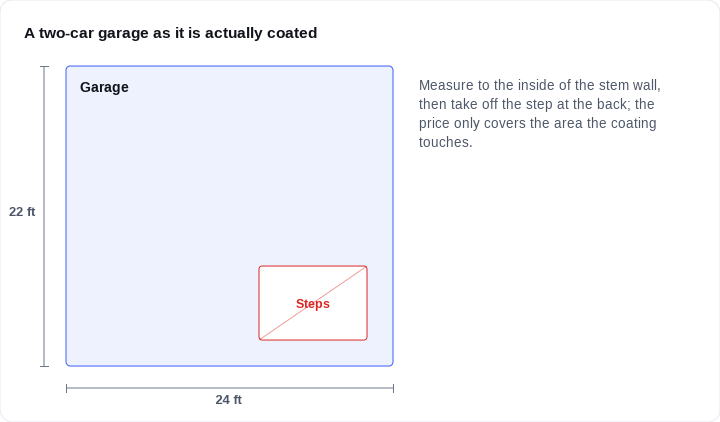
Measure to the inside of the stem wall. Deduct anything you are not coating: the pad, a built-in bench, the strip under a cabinet run. Do not deduct a column you still have to cut in around -- that is more work, not less.
Deductions matter twice. Once for the material you do not need, and once for credibility: a quote that claims 528 square feet when the customer can see the step is a quote they will question line by line.
While you are standing there, decide the things that are easy to decide now and impossible to argue later. If shelving runs along one wall, say whether you are coating under it. "We could not get behind the shelves" is not a sentence you can bill for after the fact.
The square foot is a field price, not a floor price
A square-foot rate is useful. It is how you compare jobs and how customers compare you. But it is a field rate: it covers the open rectangle in the middle. It knows nothing about how much edge the floor has.
That same 24 by 22 garage has 92 linear feet of perimeter. If the wall needs cove base, that is 92 feet of extra prep, material and labour, priced per foot and not per square foot. Put a step in the corner and the field area goes down while the edge goes up. A one-rate quote treats all of that as free, and it is the single most common reason a coating quote goes soft.
So keep two lists on the walkthrough. The field list is square feet. The edge list is linear feet and each:
- Perimeter at a stem wall: cove base, where the job calls for it.
- Steps and curbs: the tread and the riser are separate runs.
- The garage door threshold and its side returns.
- Control joints, cracks and spalls: linear feet, or each, by repair type.
- Posts, drains and other penetrations: each, because each one is hand work.
Measure each one and write the number beside it. If a condition is hidden until you grind, leave the quantity blank and carry the unit price -- that is not a weak quote, it is a quote telling the truth about what is known.
The edge is also where callbacks start. Cove base that lifts, or a step edge gone too thin, is a return trip you pay for. Pricing the edge is how you pay for doing it right the first time.
Read the slab while you are on it
The same walk should record what the slab is doing, because every one of these changes the prep and therefore the price: oil spots, tire marks, paint, old sealer, hairline cracks, wide cracks, spalls, pits, efflorescence, and anything that sounds hollow under a chain drag.
Count the cracks in feet, not in "a few". Crack repair is the line that moves most between the quote and the invoice, and feet is the only unit that survives the argument.
Then moisture, which is the failure that shows up after you have been paid. A slab passing vapour will lift a coating no matter how well you prepped it, and by then you are not quoting, you are redoing. Test before the number, not after, and write the result on the quote along with what you are doing about it: a moisture-tolerant system, a longer cure, or a straight conversation about why this floor is not getting coated today. The customer reads that as care. If you would rather not write it down, that is usually the sign it needs looking at again. There is a longer piece on how to test a slab and what the numbers mean.
Price the system, not the pail
A flake floor is not "epoxy". It is:
- mechanical prep, usually diamond grinding
- a primer, if the slab is on grade or you have any moisture doubt
- a pigmented base coat
- a flake broadcast
- a polyaspartic or urethane top coat
- cove base where the floor meets the wall
Quote that as one price per square foot and you will be compared on price. Quote it as six lines and the customer sees what they are buying -- and, just as important, you see what you are selling when the prep turns out to be double.
Two decisions inside the system are money, and both get decided by accident if you do not decide them on purpose: how much flake, and how much clear.
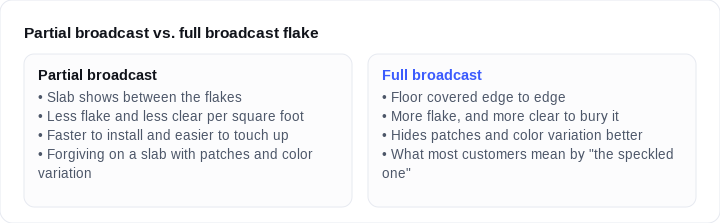
Partial broadcast leaves slab showing between the flakes and reads as a lighter, mottled floor. Full broadcast covers edge to edge and needs more clear to bury the flake so the floor does not feel like sandpaper or shed into a broom. Full broadcast is more flake and more clear per square foot -- and it is the floor most customers are picturing when they say they want "the speckled one". Write the count into the quote. "Base, full broadcast, two coats of clear" is a scope. "Clear coat included" is a coin flip, and you lose the coin flip.
A square-foot price is an output: it is what the job costs divided by the area. It is not an input you guess before you know the system.
Prep is hours, not a word
Almost every quote contains the word "prep". Almost none of them say what prep costs, because prep is invisible to the customer and unpleasant to think about.
Two garages the same size can be half a day apart or two days apart. A bare slab with light dust grinds quickly. A floor with peeling paint, or somebody else's failed coating, has to be stripped -- slow, dusty work that eats diamond tooling. Cracks get chased, cleaned and filled. Spalls get cut out, patched, and the patch has to cure before anything goes over it.
Price prep like any other labour: the hours you expect, times your rate, plus the tooling and patch material it burns. A production rate -- square feet an hour -- is the number that turns an area into a day on the calendar, and it is the thing estimators learn in their first year and never write down. If you want to see what your own rate does to a job, there is a labour hours calculator that takes an area and a rate and gives you crew hours and working days.
Use your own history, not a forum. What the last five floors like this actually cost you beats what you hope this one will.
Waste goes on each item, not once at the end
Base coat wastes differently from flake, and flake wastes differently on a rough slab than a smooth one. Eight per cent on coatings and ten on broadcast is a reasonable starting point; adjust from your own last ten jobs.
Then check the materials at pack prices rather than per square foot, because you cannot buy 2.16 kits. The difference between what the job needs and what the supplier sells is real money on a small floor, and it is the reason two quotes with the same square-foot rate can have different margins.
The lines most quotes leave off
1. Moving and protecting contents. Shelving, a freezer, two bikes and masking the drywall is an hour nobody wrote down. 2. The trip charge. Getting the crew and the grinder to site costs the same for 200 square feet as for 2,000. It is why a garage costs more per foot than a warehouse bay, and a customer who sees the line asks a better question than one who just sees a higher rate. 3. Joint and crack detail. Priced by the linear foot, and never zero on a slab older than ten years. 4. Drains and penetrations. Each one is hand work. 5. Haul-away. The old coating, the masking, the empty tins.
Some of that you will eat on purpose, and that is fine. You just cannot eat it on purpose if you never counted it.
An allowance is a guess. A unit price is a number.
An allowance is a placeholder: a dollar figure for repairs. The customer hears a number, you hope it is enough, and if the slab needs more you either absorb it or go back with your hand out. Both make the original number look soft. It also makes your quote hard to compare, because the next contractor's number may not include a repair guess at all.
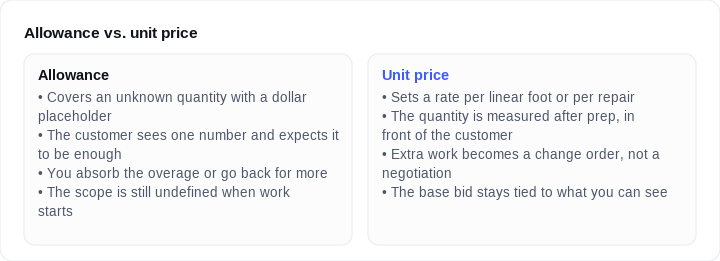
A unit price is different. Crack repair is a rate per linear foot, measured after prep. Spall repair is a rate per square foot. Coating removal is a rate per square foot. The customer agrees to the rate, not to a guess, and when the work is measured the change order is arithmetic.
That is what makes a number hold. The base bid stays tied to what you can see. The unit prices handle what you cannot. The customer can add work without asking for a new quote, and you can say yes without renegotiating the job.
Get them to initial the unit prices, not just sign the bottom. Initials are the difference between a conversation and an argument.
And give them one base bid for a defined scope, not a range. "Between this and that" tells the customer you have not finished measuring.
Where the money in a square foot actually goes
Say you quote $6.00 a square foot on that 528 square foot garage. That is $3,168, and it has to cover five things.
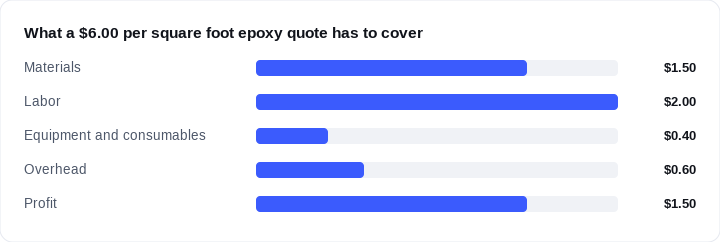
In that example, materials take about $1.50 of each square foot. Labour -- grinding, crack repair, masking, rolling, flaking, top-coating, coming back the next day -- takes about $2.00. Equipment, blades and rollers take $0.40. Overhead takes $0.60. Profit is the last $1.50.
Now run the day that goes wrong. Prep takes longer than planned. That money comes out of the last bar, because it cannot come out of materials and it cannot come out of overhead. Twenty extra minutes per hundred square feet across a garage this size is the profit.
Which is the argument for naming the prep you might need inside the number instead of hoping you will not need it. Not padding. Naming. If your own history says one garage in five needs more crack repair than expected, put a unit price on the quote and write down what happens when it is used.
Your numbers will not match the ones above and they should not. The point is that you should know yours, per square foot, before you say a price out loud -- and that margin and markup are not the same number, which is its own five-minute problem worth getting right once.
Write down what is not included
The exclusions are the part of the quote that holds. Plain sentences, above the signature line:
- Grinding of the full coated area is included.
- Crack repair is included up to a stated length. Past that, it is the
per-foot price, as a signed change order.
- Spot treatment of oil and grease is included. Stains that have soaked into
the slab are not.
- Existing coatings, sealer, paint and spalling are not included. If we find
them once the floor is ground, work stops and we re-price.
- The garage is empty, clear, and has power and water on the day we start.
Say who moves the stored boxes, who removes the old shelving, who repairs drywall. Say when they can walk on it, when the car can come back, when the shelving can be reloaded. A customer who is told one cure time and hears another from a neighbour will call you; a customer who sees the day count on the quote has a reason to trust the rest of it.
Exclusions are not a warning to the customer. They are an agreement between two people about where the job stops.
Photos, deposit, and two follow-ups
Phone photos cost nothing. The whole floor from the door, each crack, the oil stains, the step, the moisture reading, the spot where the old coating is lifting. Attach them. Two things happen: when you tell the customer the crack ran further than it looked, they remember the picture -- and when the next bidder says the floor can be flat and smooth for less, your customer is holding a written scope that says what "less" leaves out.
Then the money. A deposit on signature, before materials are ordered, so the resin in the back of the truck is the customer's money and not yours. State the balance terms on the same page as the scope, not in a text message after the job.
And most quotes that go cold are not lost on price. They are lost because nobody asked again. Two follow-ups, spaced out, with the scope attached to the second one. A quote sitting in a message thread is worth nothing.
Read it twice before you send it
Once as the customer: can you tell what is being coated? What is not? What changes the price? What do you have to do before the crew arrives?
Then as the contractor: did you measure cove and stem wall? Did you record the moisture test? Did you price the cracks? Is there enough margin to cover the time you will actually spend?
That is the whole job. Here is what one looks like finished -- a 24 by 22 garage, line by line, with the quantity each line came from. If you want to put your own numbers through it, the cost calculator does the same arithmetic with your rates.
It is also, frankly, the argument for drawing the room where you are standing. Drawlite measures the drawing, prices it from your own price book, works out the tax and puts the quote in front of the customer to sign before you leave. The square footage on the quote is the square footage you walked, and the perimeter comes off the same outline, so the cove base cannot go missing.
The number holds when the scope holds
You cannot control the slab. You can control whether the quote describes it. Measure the floor you are coating and the edge around it, read the slab, pick the system, price the prep in hours, put unit prices on the unknowns, write the exclusions, attach the photos, and take the deposit.
Then the work outside the scope is a change order instead of a haircut, and the number you said in the driveway is the number you get paid.