What Belongs on a Quote a Homeowner Will Actually Sign
The signature is a trust decision
A homeowner is not comparing your arithmetic to another contractor's. They are deciding which stranger to let back into the house. The quote is most of the evidence they have. Big numbers don't calm anybody down. Specific ones do.
Most unsigned quotes don't lose on price. They lose because something on the page is missing and the homeowner can't tell whether it's missing on purpose or by accident. So they wait for a callback, or a better feeling, and the quote goes cold in a folder.
What follows is about the content of the page, not the number on it.
One price, one scope
Put one number at the top for the whole job. Break it down underneath.
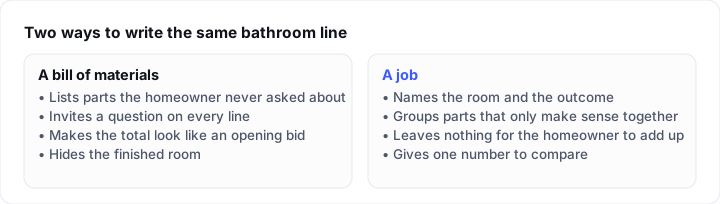
A quote with fourteen line items and no total asks the homeowner to do addition, and a homeowner doing addition starts finding reasons to call somebody else. The lines under the total should read as work, grouped by room or system, the way the homeowner describes the job to their spouse. "Hall bath: tear-out, tub to shower, tile, fixtures, paint" is something they can picture buying. "1/2 in. drywall, 12 sheets" is a receipt from a store they didn't shop at.
You don't owe the homeowner your markup. You do owe yourself a check that the price holds before the quote goes out. Run the cost and the price through the markup vs margin calculator and fix it on your side of the page.
Say what is not included
Every job has edges. The homeowner finds them either on the page or in week three. On the page, an exclusion is a reason to trust you. In week three, it's an argument.
Write them as plain facts:
- Price does not include replacing subfloor that turns soft after tear-out. If we find it, we stop and price it before we go on.
- Tile is allowed at a set rate per square foot. Anything above that is billed as the difference, approved before the tile is ordered.
- The paint price covers two coats over the existing color. Going from a dark wall to a light one may need a primer coat, priced separately.
Three sentences, and the homeowner knows where they stand. Skip "including but not limited to." That phrase tells them the surprise is coming.
Selections, by name
If the price includes a vanity, a faucet, a tile or a light, name it. Brand and model, or a stated allowance with the rate per square foot or per unit. A homeowner who can read what they picked doesn't call you in week two to ask.
An allowance is not a weakness. It is an honest line for something not chosen yet, with the rule for what happens when they choose up. That rule is the part that keeps the number from moving without a conversation.
Name the number you measured
If the price is tied to a quantity, show the quantity and where it came from. The homeowner is not going to check your math. What they get from "32 sq ft of floor" is that you were in the room with a tape instead of guessing from the driveway.
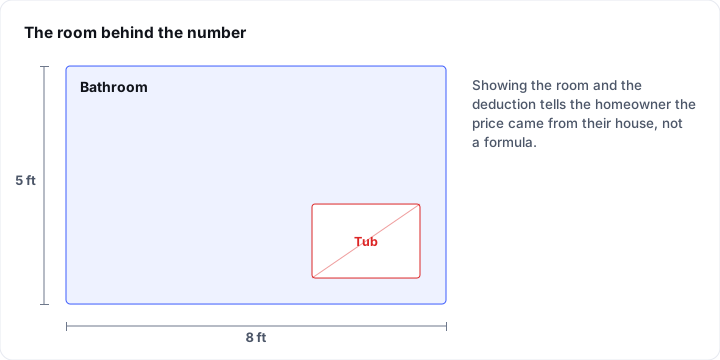
The same goes for anything that came off the measurement: a tub, a cabinet run, a closet. The deduction should be visible, not netted into a figure that appeared from nowhere. When a homeowner can see their own bathroom in the arithmetic, the price stops sounding like an opinion.
This is the part Drawlite handles. You draw the room on the phone, it measures the drawing, and the quote carries those quantities instead of your memory of them.
What changes the price, and how it gets approved
Hidden conditions are where signed quotes turn into fights. You can't list them all, but you can say what happens when one shows up.
Put your rate for extra work on the page: the hourly figure, or the per-unit price for added scope. Then say how a change gets approved. In writing, before the work, with the amount agreed first. A homeowner who knows the process doesn't panic when it starts.
When the money is due
The payment schedule belongs on the quote, in a short list. What's due to start, what's due at each milestone, what's due at the end. One line each.
Most homeowners have been burned, or know somebody who has. A clear schedule isn't an insult to them. It is evidence you have done this before. If the schedule is a surprise at signing, the signature waits.
The order the page reads in
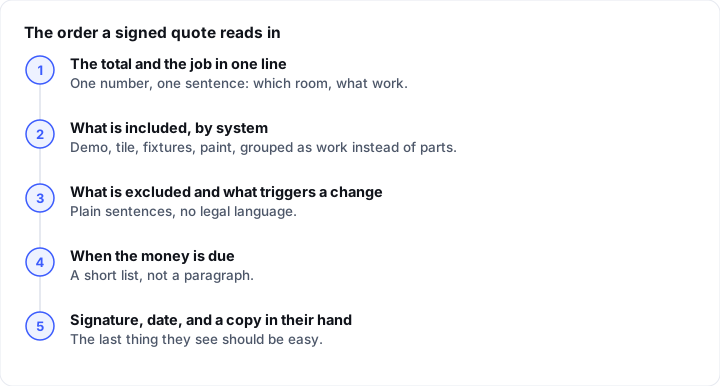
Homeowners read the total first, then look for what's missing. Build the page to answer in that order.
Everything else stays off the page
Your material costs, your supplier names, your labor burden, the notes you wrote to yourself at the kitchen table. None of it helps the homeowner sign, and some of it starts a negotiation you don't want to have.
What stays is the price, the scope, the exclusions, the change process, the payment schedule and a signature line. If a line on the quote doesn't help the homeowner decide, it is costing you a job you already did the work to win.
Send the finished page with a copy they can keep. If you want to know what Drawlite costs before you try it, it's on the pricing page.