Reading a takeoff: waste factors that quietly eat a margin
The number you measure is not the number you buy
You measure the floor, you get 516 square feet, and 516 goes on the quote. Then you order 516 square feet of material and the job eats the difference. There is no invoice line called waste. It shows up three weeks later as a second trip to the supplier, a thinner check at the end of the month, and a job everybody thought made money.
The takeoff is where that gets decided. Not the labor rate, not the markup — the quantity. Price a job off the net measurement and you have decided, before you pull into the driveway, to donate the waste.
Net first, then waste
Measure the space. Deduct what you are not covering: the step into the garage, the closet, the cabinet run, the hearth. Land on one honest net number.
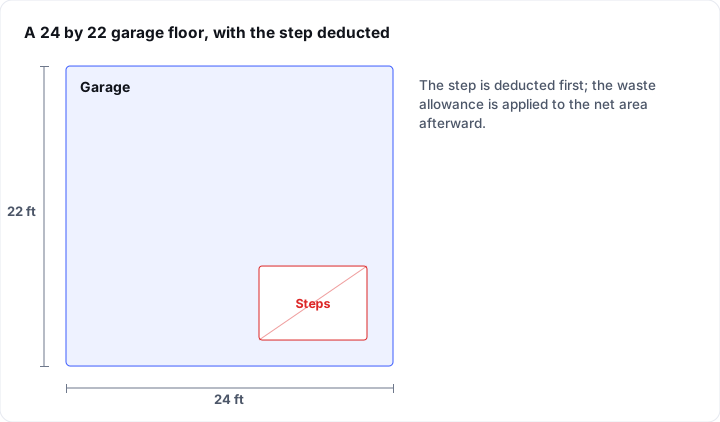
A 24 by 22 garage is 528 square feet on the slab before you take out the step. That net figure is the only number worth arguing about. Everything after it is an allowance you choose. The mistake is choosing it by accident, which is what happens when waste gets baked into a square-foot price you set two years ago and have not looked at since.
Where the waste hides
Cutting waste. The offcut at the end of a row, the piece around a doorway, the last course against an angled wall. A plain rectangle and an L-shaped room with three doorways are not the same allowance even when they measure the same.
Pattern and layout. Plank with a stagger, tile with a repeat, anything with a direction. A layout that needs a minimum offcut length means cutting a full board to get a short piece. Sheet vinyl with a pattern costs you more at the seam than plain goods does.
The order unit. Nobody sells 557 square feet of plank. They sell cartons that hold 24 square feet. The difference between what you need and what you can actually buy is waste, and it is never small.
Damage and the reserve. The piece you cut wrong, the corner that chips, the call-back eight months later. Without a unit held back, a repair means a new order and a dye lot that does not match the floor you installed.
Overlap and trim. Sheet goods, underlayment, house wrap, drywall, siding. You buy a 4 by 8 and cut off 14 inches. The offcut is waste and it was not free.
Notice that four of those five have nothing to do with how carefully the crew works. Good installers still throw away the end of a row. The waste is in the shape of the room and in the way material is sold.
What the waste costs on one floor
Take that garage: 516 square feet net after the step. Plank at $2.40 a square foot, cartons holding 24 square feet.
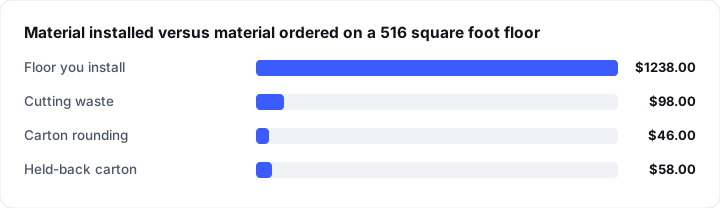
- Cutting waste at 8 percent, the allowance this example uses for a floor with a closet and four corners: 41 square feet, or $98.
- Round up: 516 plus 41 is 557, and 557 rounds to 24 cartons, which is 576 square feet. Nineteen square feet of rounding, or $46.
- One carton held back: 24 square feet, $58.
You order 25 cartons — 600 square feet, $1,440. You install 516 square feet, $1,238 worth. The $202 in between is money you spent.
If your square-foot price was built from the cost of 516 square feet, that $202 comes out of your profit. On one garage floor. Now run it across every job for a year.
Waste is material, not labor
Here is where the allowance gets applied wrong. You throw away material, not labor — nobody pays a crew to install the offcut. So a waste percentage applied to the whole line charges the customer for labor you never spent, and covers the material at a rate that has nothing to do with the material.
Apply the factor to the material cost, and nothing else. Then it explains itself on the quote — we order 25 cartons to cover the layout — instead of looking like padding, which is the first thing a homeowner cuts.
The other version of the mistake is counting it twice: waste added to the quantity, and then a waste percentage added to the price. The job makes money and the quote comes in high, and you spend a month wondering why you are losing bids you should win. The markup versus margin calculator will show you what a given price actually returns, which is usually the moment the double count shows up.
Round to the purchase unit, then stop
Do the rounding last, after the waste, and round up. The round-up is not sloppiness — it is the order unit. Price the order unit and the takeoff tells the truth. If you want the arithmetic laid out for a specific material, the flooring waste calculator takes the room, applies the waste and rounds to whole cartons.
Then hold one unit back and put it somewhere dry. It costs you at the order and saves you at the call-back.
The read-through before the quote goes out
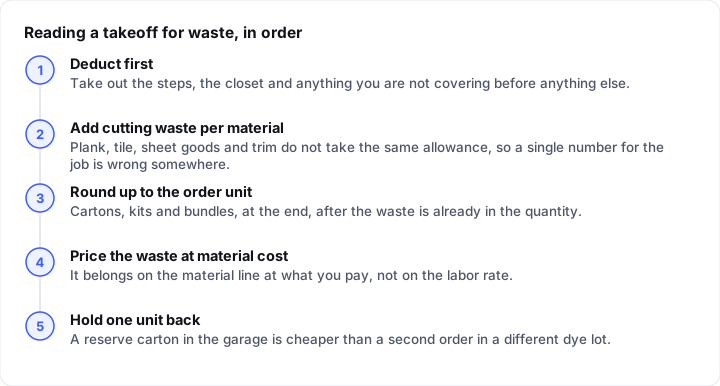
Five lines, in order, and no quote leaves without them: net quantity, waste per material, order unit, waste priced at cost on the material line, reserve. If a takeoff survives that read-through, the number in the quote is a number you can defend, and the margin you penciled is the margin you get.
Fix the price book, not the quote
The quiet damage is in the price book. If the per-square-foot material cost in there came from net measurements on old jobs, every quote built from it carries the same leak, and no amount of care at quote time repairs it. Fix the number once. Put the allowance in the template you reuse for that kind of job, and it holds whether you are quoting at nine at night or standing on a ladder.
Drawlite measures the room you drew on the tablet and prices it from your own price book, so whatever allowance lives in that price book is what every quote inherits. The shopping list comes off the same drawing, which means the quantity you order is the quantity on the takeoff instead of a second guess at the counter.