Change Orders Without Losing the Customer
The change shows up at the worst moment: a wet wall, a cabinet that will not fit, a homeowner with a new photo. You need an answer, and the customer needs to feel safe.
Most contractors lose the customer there, not because the extra costs money, but because the money is a surprise. The fix is a process the customer can see coming.
The extra is not the problem; the surprise is
At the start, tell the customer how changes work. Put it in the quote: what is included, what is not, and what happens when you open a wall and find something you could not see.
One sentence does a lot: "If I find something that changes the scope, I will stop and send you a one-page change order with the price before we go further." Now the customer knows the rule. A change order is not a penalty. It is the rule being followed.
"We'll deal with it later" sounds easy. Then the end of the job arrives and the customer feels tricked. The contractor who sends a clear change order early is not the one who nickel-and-dimes. They are the one who told the truth before the drywall closed.
Put the reason in the customer's language
"Reframe 12 LF" tells the customer nothing. "The wall behind the tile is wet; the old framing has to come out before tile can go back" gives them a reason.
Say what happens if the work is not done. "Tile will not bond to wet framing." "The cabinet run will not fit the opening with the old wall in place." Keep it plain. Do not make the customer feel stupid for asking.
If it is an upgrade, say so. "This is a choice, not a repair." A customer will pay for a nicer finish when they know it is optional. They will fight a required repair that looks like an upsell. Put required items first, optional items second, and label both.
A change order is a small quote
A change order has the same parts as a quote: reason, scope, price, and a yes. The process is stop, price, send, get a yes, collect before ordering. The part contractors skip is the second one: price it from your own price book, not from a guess in the driveway.
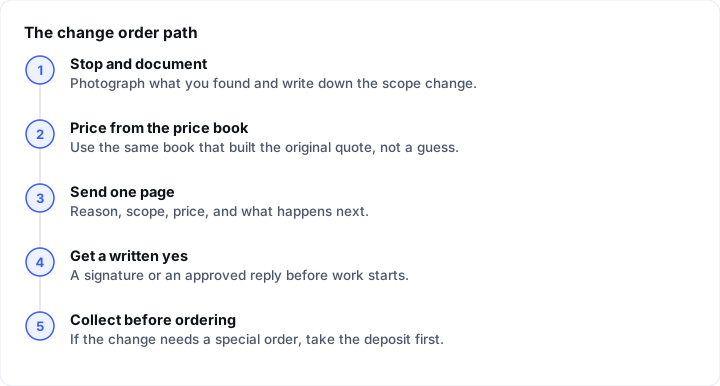
Drawlite fits here because a change order is just a small quote. Draw the change, price it from the same price book that built the original quote, and send it for a yes. When the change order is fast, you send it while the customer is still standing there. When it is slow, it becomes an argument at the end.
The two ways a change goes wrong
The verbal path feels faster. "Go ahead, we'll settle up at the end" sounds friendly. Then the customer remembers a different number, or forgets the conversation, and you are arguing about a memory.
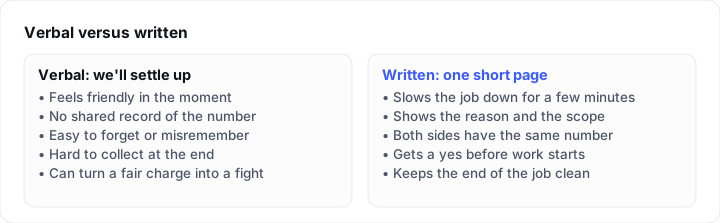
The paper path feels formal. That is the point. It gives both sides the same record, and it forces you to price the work while you can still say no.
If a signature feels heavy for a small change, send a short message with the scope and price and ask for a reply that says approved. Keep it in the job file. A written yes is better than a verbal yes.
Show the breakdown, not just the total
A total with no backup invites a fight. The customer sees "$720" and thinks about their budget. They do not see the crew time, the material, the dump fee, or the margin that keeps the doors open.
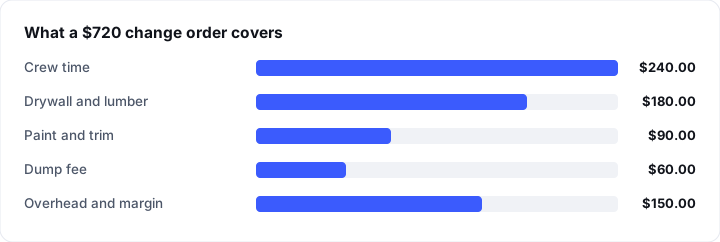
Here is a worked example, not a market price. A homeowner asks to add a six-foot knee wall between the kitchen and the hall. Two crew members spend three hours at $40 an hour: $240. Lumber, drywall, screws and compound: $180. Paint and trim: $90. Dump fee: $60. Overhead and margin: $150. Total: $720.
The customer does not need every screw. They do need to see that the $720 is not your fee. It is work, material, disposal, and the cost of staying in business. When they can see the parts, they can see what to remove if the number is too high.
If you price by hours, the labor hours calculator turns an area and a production rate into crew hours and a labor cost per square foot. Use your own numbers. The point is the trail, not the calculator.
Bundle the small ones, separate the required ones
A change order for every little thing wears a customer down. If they ask for three small additions after the same walkthrough, put them on one page: one reason, one scope, one total, one yes.
But do not bundle a required repair with an optional upgrade. "The framing is wet and you also asked for a niche" is two decisions. The customer may say yes to the repair and no to the niche. That is fine. You still have a dry wall and a customer who feels in control.
A tiny change order can cost as much goodwill as a big one if it arrives as a surprise. Send it anyway. The customer who sees the process early is harder to surprise later.
Do not wait for the end of the job
The worst place for a change order is the last payment. By then the work is done, the money is spent, and even a fair charge reads like a trap.
Send the change order the same day you find the change. If you cannot price it yet, say so: "I need to check the material cost. I will send you the number before we touch it." Then do that. The waiting is fine. The silence is not.
If the customer says "just do it," write it down anyway. Send a short message: "You approved the added knee wall for $720. I will start tomorrow." That message protects both of you. It is not a lack of trust. It is a record.
When the customer pushes back
Do not defend the number. Ask what part is the problem. Maybe the total is fine but the timing is not. Maybe the upgrade is too much but the repair is not.
Offer choices, not pressure. "We can do the required repair now and leave the niche for later." "We can use the tile you picked, or choose a less expensive tile and keep the same scope." "We can pause this section until you decide."
Do not cut required work to save the sale. You can defer a nicer finish. You cannot defer wet framing. If the customer cannot afford the repair, say what happens if it is not done, then let them decide. A signed change order for less work is better than an unsigned change order for work you should not do.
The customer is not the enemy of the change order. The surprise is. A clear reason, a short page, a real number, and a yes before the work starts will keep more customers than a discount will.