After the Job: How to Tell Which Jobs Lost You Money
The check cleared. The customer was happy. Then the material bill came in, the dumpster charge hit the card, and the helper's hours were two days more than you wrote down. You did not lose the job. You lost money on it. Those are different things.
The worst jobs are not the ones that blow up. They are the ones that look fine from the truck. A garage floor quoted at $3,200, finished in two days, paid in full. Nothing to argue about. But if the labor ran 28 hours instead of 22 and the patch sub sent a bill you forgot to price, the job made nothing. You only find that out if you go back and match the quote to what actually happened.
Why the bank balance lies
Your bank balance is a sum of every job, every deposit, every material bill, and every tank of fuel. A good job on a commercial build can hide a bad week of small residential work. A deposit that lands on Friday makes a losing job look profitable until the material bill clears on Monday. The bank balance is not wrong. It is just too late and too lumped together to tell you which job caused the problem.
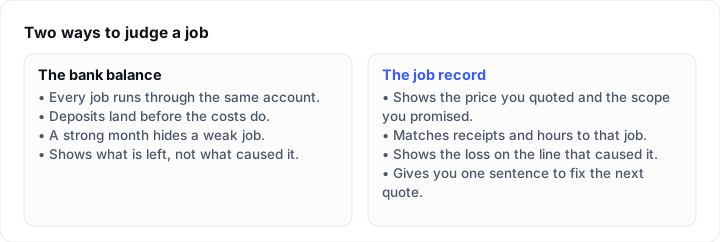
To know which jobs lost money, you have to look at one job at a time. That is the whole method. It is not a big reporting project. It is a post-mortem.
Start with the quote you sent
The quote is the only record of what you promised and what you expected to make. If it was a text message and a number, write it down now. If it came out of your own price book, the work is easier: the line items already have a cost and a price. That is the point of a price book — not paperwork, but a record you can check later.
Pull the final version, not the first draft. Add every change order you sent, even the one you did for free because the customer was nice. Add the deposit and the final payment. Now you have the money side. The cost side is receipts, hours, and subs.
Miss any of those and the review lies to you. A missing dumpster receipt can turn a $200 loss into a $200 profit. A patch sub paid in cash can disappear. The point is not to be perfect. The point is to find the line that keeps going wrong.
The five-minute post-mortem
Set a timer. You are not writing a report. You are answering one question: did this job make money, and if not, which line ate it?
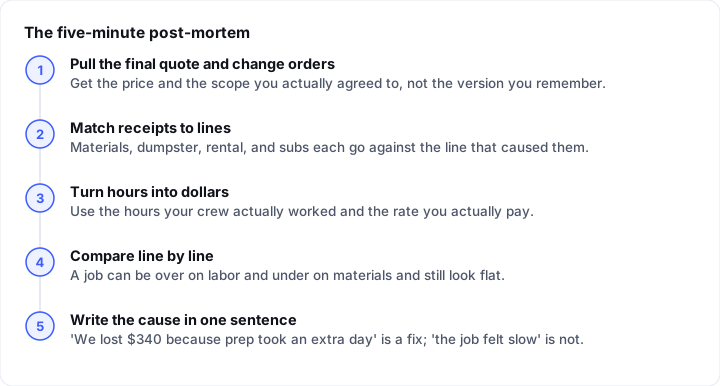
Five steps is enough. Most contractors already have the quote and the receipts. The missing piece is the hour count. If you do not track hours by job, start with the days. Two guys for two days is a number. You can turn that into dollars at the rate you pay. It will not be exact. It will be close enough to show you the pattern.
Compare line by line, not total to total. A job that came in $50 over could be $400 over on labor and $350 under on materials. If you only look at the total, you learn nothing. The overrun is on labor. The next quote needs more labor hours or a smaller scope, not cheaper material.
If you need a starting point for hours, the labor hours calculator turns an area and a production rate into crew hours and a labor cost per square foot.
A job that lost money, line by line
Here is a plain example, not a benchmark. A 400-square-foot garage floor quoted at $3,200 — $8 a square foot. The crew finished in two days. The customer paid without a callback. On the bank statement, it looked like a good week.
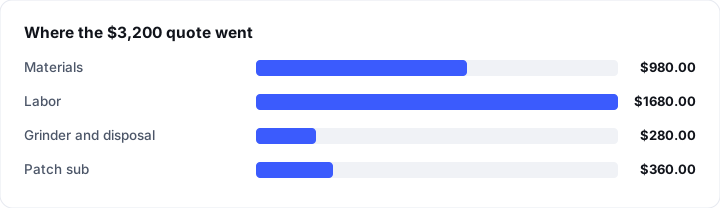
Then the receipts came in:
- Materials: $980
- Labor: 28 hours at $60 an hour = $1,680
- Grinder rental and disposal: $280
- Patch sub: $360
Total: $3,300. The quote was $3,200. The job lost $100.
That is not a crisis. It is a signal. The quote assumed 22 hours. The job took 28. The extra six hours cost $360. The job would have made $260 if the hours had held. The fix is not 'work faster.' The fix is to price the prep at the hours it actually takes, or to qualify the floor before you quote it.
The causes repeat
After five or ten of these, you stop seeing individual jobs and start seeing causes. The same three or four show up:
- Prep takes longer than the quote says.
- Materials get ordered with no waste factor, then a second trip.
- A change order gets done for free because it felt small.
- A small job gets the same setup cost as a big one, but no minimum charge.
- The price book line is old and no longer covers the cost.
Pick the one that shows up most. Fix it in the price book, not in your memory. If prep keeps running long, change the labor line for that job type. If the same material keeps coming up short, change the waste factor. If change orders keep getting eaten, put a price on the small ones. If a job type never makes money, stop selling it or raise the minimum.
The point of the review is not to feel bad about the last job. It is to change the next quote. A price book that gets updated from real jobs gets more accurate every month. A price book that gets updated from guesswork does not.
When you change a price, check the margin, not the markup. The markup vs margin calculator turns a cost and a price into the margin you actually made, or a target margin into the price you have to charge.
Put the fix in the next quote
A post-mortem that stays in your head changes nothing. Put the fix where the next quote will see it. If the prep on a garage floor runs long, put the real prep hours in a reusable job template. If the material line is short, change the price book. If the change order was free, add a line for it. If the job type never made money, qualify it out before you drive over.
The review should take less time each month, not more. You are not building a file for every job. You are looking for the one or two lines that keep showing up. Those lines are where the money went.
Use the record you already have
Most contractors do not need more paperwork. They need the quote and the receipts in the same place. If you quoted the job in Drawlite, the price book line and the quote are the same record, so the post-mortem starts with the numbers you already have. That is the advantage: the quote is not a separate document you have to reconstruct from memory.
The job that lost money is not a failure if you catch it. It is a price change. The contractor who knows which jobs lost money does not guess on the next one.