Deposits: How Much to Ask For and When to Ask
The deposit conversation usually happens after you have measured the room and priced the job. The customer is interested, you want the work, and the number you say next is often whatever you said last time. That is how contractors end up buying a tile package on a credit card and waiting six weeks to get paid.
A deposit is not a test of the customer's character. It is working capital. Decide the rule before you walk in.
The deposit is not a down payment on goodwill
A deposit is not a tip for showing up, and it is not a reward for a good presentation. It is the money that lets you order the job.
You are not a bank. If the tile, the vanity, the permit, and the dumpster all have to be paid before demo day, that money has to come from somewhere. If it comes from you, you are financing the customer's remodel. Sometimes you have to do that. But you should know you are doing it.
A deposit also does one more thing: it turns a conversation into a commitment. A customer who pays a deposit has decided. A customer who says 'let's get started' but has not paid has not decided.
Start with what you have to spend before you swing a hammer
Open the quote and mark every line you pay before the first day of work. Special-order material. Custom fabrication. Permit fees. Dumpster delivery. Equipment rental. Any sub who wants money to hold a date.
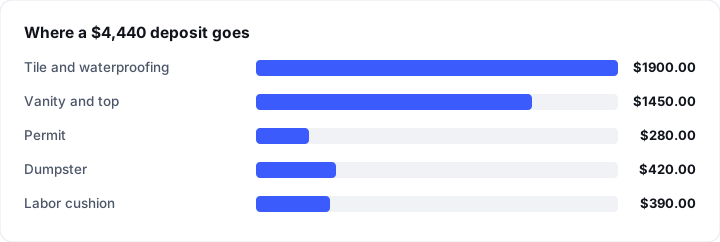
Add those up. That is your floor. The deposit should cover at least the money you cannot get back if the job stalls.
Then add a small cushion. Not because you do not trust the customer, but because the first few days of labor come before the first progress payment. If the deposit only covers material, you are still financing the crew.
Here is a plain bathroom example. The contract is $14,800. Tile and waterproofing are $1,900. The vanity and top are $1,450. The permit is $280 and the dumpster is $420. A $390 labor cushion covers a small material run and a helper day. That totals $4,440, or 30 percent of the job. The deposit is not a guess. It is the bills that arrive before the work does.
On a job with custom cabinets, the cabinet shop may want half at order. Your deposit has to include that half. That can push a deposit well past 30 percent, and that is fine if the number is explained. You are not padding the deposit; you are passing through a real order cost.
On a paint job or a small repair with stock material, the pre-start spend may be a few hundred dollars. Your deposit can be smaller. You are covering risk, not hitting a percentage because it sounds standard.
Put the deposit on a milestone, not a mood
The deposit is due when the contract is signed. Not when the customer gets paid. Not after demo. Not 'once we get going.' At signing and before any order is placed.
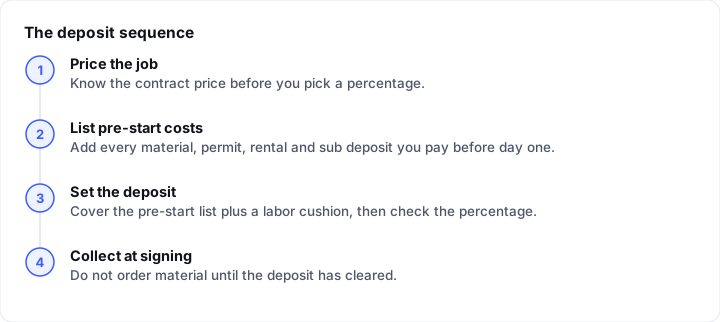
That timing matters more than the percentage. A 40 percent deposit collected after materials are on site is a reimbursement. A 25 percent deposit collected before the order is working capital.
If the customer needs a week to move money, fine. Put the job on hold and do not order. The order is the commitment. If the cabinet shop builds your boxes and the customer changes their mind, you own the boxes.
For larger jobs, a deposit is not the whole payment plan. Set progress payments against visible milestones: demo complete, rough-in done, cabinets set, final walk. Each payment should keep your exposure small. The deposit protects the start. The draws protect the middle.
Put the deposit and the remaining balance on the quote. With Drawlite, the deposit and the money owed can sit on the same quote the customer signs, so there is no side conversation about what is due at signing.
Don't let the deposit become the only payment
A deposit at signing and nothing until the final walk is better than no deposit. It is still a bad payment plan.
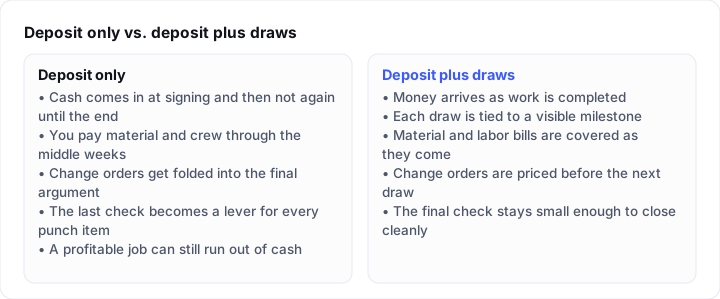
On a six-week kitchen, you pay the cabinet shop, the countertop fabricator, the electrician, and your crew before the final check. If the only money you have collected is the deposit, you are funding the middle of the job out of your own account. That is how a profitable job turns into a cash problem.
Progress payments are not a lack of trust. They are the normal shape of a construction contract. The customer pays as value is delivered. You do not have to carry the job to prove you are solvent.
Keep the final payment small enough that a punch list does not hold your whole profit hostage. If the last check is 30 percent of the job, every small fix becomes a negotiation. If it is 5 or 10 percent, the customer has a reason to finish the walkthrough and you have a reason to fix the list.
What to put in writing
The deposit should not live in a text message. Put it in the quote or contract, in plain words:
- The exact deposit amount and what it covers.
- When it is due — at signing, before ordering.
- How it applies to the contract price.
- Whether any part is refundable, and under what conditions.
- The balance schedule: what is due at each milestone.
- What happens if the scope changes.
The refundable question matters. If you are ordering custom cabinets, that money is not refundable to you, so it should not be refundable to the customer just because they changed their mind. Say that before they pay, not after.
If the customer pushes back
Listen first. Then explain the order. 'The tile and vanity are $3,350 and I cannot return them. The deposit covers those, the permit, and the dumpster. The rest is paid as the work is done.'
If they still will not pay it, do not order material. Offer a smaller scope or a stock package. Do not cut the deposit on the same special-order job. That is not a compromise; it is you taking the risk.
A customer who will not pay for materials is asking you to finance the job. Sometimes the right answer is no. The job you do not take has better margin than the one you fund.
The number is a business decision
Set the deposit from your costs, not from what feels confident. Run the pre-start list. Add the cushion. Compare the number to the contract price. If it comes out at 18 percent, say 18 percent. If it comes out at 45 percent because of custom cabinets, explain the cabinet order. The percentage is an output, not a rule.
Do not confuse the deposit with profit. The deposit is revenue you have not earned yet. It sits against the job until you buy the material and do the work. If you spend it on payroll for a different job, you have not solved your cash flow; you have moved it.
If you need to see what a job actually leaves after cost, the markup vs margin calculator will show you the margin in a price. If you need to know what a crew day costs before you set a labor cushion, the labor hours calculator turns area and production rate into hours.
Then write the rule down. Deposit due at signing, before any order. Amount covers pre-start costs plus a cushion. Balance paid at named milestones. That is the whole policy. The next time a customer asks 'how much down?' you will have an answer before you open your mouth.